I'm back in New York, and my work here is ended. I'll close by noting that last time back, what struck me was how big the elevators are. This time, it is how late the stores stay open. A Parisian-style patisserie has opened on our corner, and we went by it to see. They're open until 10p, which is NOT Parisian at all. But I like it.
Thanks for reading, and I hope to see many of you soon.
Sunday, February 15, 2009

Friday, February 13, 2009
Soyez Mon Valentin?
Valentine's Day is, to my slight surprise, celebrated in France.
For the most part it's done in their typically understated fashion. I haven't seen any greeting cards that specifically mention Valentine's Day (but then, this is not a greeting-card culture), and few places have put up tacky (or even tasteful) decorations.
The main point of the holiday seems to be, unsurprisingly, food. A number of restaurants have put up discreet signs advertising special "Saint-Valentin" menus, and my local luxury-food store was advertising (without actually citing the holiday) foie gras for two with sweet wine before the fire. (A bit different than the typical American menu, that.)
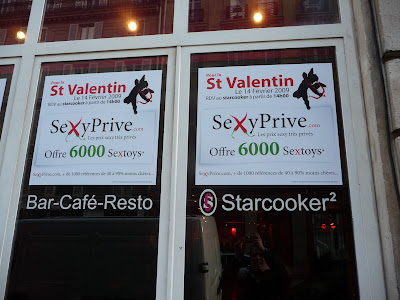
But there is one industry that loudly and publicly celebrates Valentine's Day -- the sex shops:

For the most part it's done in their typically understated fashion. I haven't seen any greeting cards that specifically mention Valentine's Day (but then, this is not a greeting-card culture), and few places have put up tacky (or even tasteful) decorations.
The main point of the holiday seems to be, unsurprisingly, food. A number of restaurants have put up discreet signs advertising special "Saint-Valentin" menus, and my local luxury-food store was advertising (without actually citing the holiday) foie gras for two with sweet wine before the fire. (A bit different than the typical American menu, that.)
But there is one industry that loudly and publicly celebrates Valentine's Day -- the sex shops:


Thursday, February 12, 2009
The Seven Habits of Highly Effective French Restaurants
Want to open a truly authentic French restaurant in the United States? Here are seven things you should do that the American crowd will find impossible to believe:
1. Keep the lights on as bright as you can.
2. Don't serve the bread until the appetizer arrives.
3. Serve wine in the smaller glass and water in the larger glass.
4. Always undercook the meat.
5. Insist on taking the dessert order at the same time as the appetizer and main course.
6. Refuse to serve coffee until after the dessert has been finished.
7. Be closed on at least one weekend day, if not both, and for four weeks in either August or January.
1. Keep the lights on as bright as you can.
2. Don't serve the bread until the appetizer arrives.
3. Serve wine in the smaller glass and water in the larger glass.
4. Always undercook the meat.
5. Insist on taking the dessert order at the same time as the appetizer and main course.
6. Refuse to serve coffee until after the dessert has been finished.
7. Be closed on at least one weekend day, if not both, and for four weeks in either August or January.
Tuesday, February 10, 2009
There's a Cork on the Road
It shouldn't surprise anyone that the French love for food and wine permeates their popular culture, including slang.
The word "bouchon" means a cork, but it seems to also be a term for traffic jam, as this sign warning of construction on a major southern highway indicates:

The word "bouchon" means a cork, but it seems to also be a term for traffic jam, as this sign warning of construction on a major southern highway indicates:

Sunday, February 8, 2009
Sign of the Times
Twenty years ago it would have been shocking to see signs in the Paris Metro advertising English classes. But now, they're everywhere.
The biggest advertiser is an outfit named Wall Street Institute, but it seems their brand equity may no longer be what it used to be:

The biggest advertiser is an outfit named Wall Street Institute, but it seems their brand equity may no longer be what it used to be:

Saturday, February 7, 2009
La Cuisine Americaine
I was reminded today that the country I'm returning to in a week is, to the French, a foreign and even exotic land.
In the international section of the food hall of one of the big Parisian department stores is a shelf devoted to food of the United States and Canada:

If you look closely at the picture you can see what the French consider worth importing from North America: popcorn, pancake mix, peanut butter and roasted peanuts, barbecue sauce, cranberries, molasses and that harsh yellow stuff Americans call mustard. (The Canadian contribution, as far as I could tell, was limited to maple syrup.)
Truth be told, there is nothing on that shelf that I've missed in six months of living here.
In the international section of the food hall of one of the big Parisian department stores is a shelf devoted to food of the United States and Canada:

If you look closely at the picture you can see what the French consider worth importing from North America: popcorn, pancake mix, peanut butter and roasted peanuts, barbecue sauce, cranberries, molasses and that harsh yellow stuff Americans call mustard. (The Canadian contribution, as far as I could tell, was limited to maple syrup.)
Truth be told, there is nothing on that shelf that I've missed in six months of living here.
Thursday, February 5, 2009
Voulez-vous un sandwich?
I think it was Paul Theroux who said that the French get the same frisson from using certain English words as English-speakers do when they use the word frisson.
"Sandwich" is certainly one of those words.
Sandwichs, to use the French plural (no "e" before the "s") are very common here but they are almost always made on split baguettes rather than sliced bread:

Popular fillings include ham and cheese, salami or similar types of dried sausage, tuna salad and occasionally chicken. The first sandwich I ever had in France, in 1988, was made with pate but that is very hard to find now, for some reason.
They are made and served in virtually every bakery and cafe, usually for less than 5 euros ($6.50) apiece. "Sandwichs" are not luxury or exotic items by any stretch of the imagination.
Still, nearly every bakery sells them in specially labeled bags just in case you might not understand what's inside:

"Sandwich" is certainly one of those words.
Sandwichs, to use the French plural (no "e" before the "s") are very common here but they are almost always made on split baguettes rather than sliced bread:

Popular fillings include ham and cheese, salami or similar types of dried sausage, tuna salad and occasionally chicken. The first sandwich I ever had in France, in 1988, was made with pate but that is very hard to find now, for some reason.
They are made and served in virtually every bakery and cafe, usually for less than 5 euros ($6.50) apiece. "Sandwichs" are not luxury or exotic items by any stretch of the imagination.
Still, nearly every bakery sells them in specially labeled bags just in case you might not understand what's inside:

Tuesday, February 3, 2009
Start a New Life
If any of you have a past you want to run away from, the French Foreign Legion awaits you ...

... yup, it's still in business after all these years ...

... yup, it's still in business after all these years ...
Monday, February 2, 2009
Winter Wonderland, for 45 minutes
It snowed today! Apparently we got the edge of a big storm that paralyzed London.
Snow was falling and about a half-inch was already on the ground when I got up to go to the gym at about 8 a.m. (i.e. before sunrise). When I got back, the sun had risen and it had turned to rain and started melting, so the pictures didn't come out all that well, but here they are:


Snow was falling and about a half-inch was already on the ground when I got up to go to the gym at about 8 a.m. (i.e. before sunrise). When I got back, the sun had risen and it had turned to rain and started melting, so the pictures didn't come out all that well, but here they are:


Sunday, February 1, 2009
Still Breathtaking
Even after six months here, sometimes I see something that just takes my breath away:

This is a view from place de la Madeleine, home to some of Paris's top food shops, up the boulevard des Malesherbes to the church of St. Augustine. I was walking around the plaza and just stumbled on this yesterday.
This church isn't even mentioned in my guidebook's chapter on "The Major Churches," which must tell you something all by itself. Maybe there's nothing worth seeing inside, but it's still startling to round a corner and see something like this.
I'm guessing that we have Baron Haussmann to thank for this -- he's the guy who rebuilt Paris in the 1860s into a city of boulevards, and what he seems to have done is just taken the existing landmarks and bulldozed boulevards strategically between them. So you get vistas that you don't get in, say, London, which also has a pretty good selection of landmarks but (for better or worse) never had a Haussmann or a Napoleon III to open up the vistas.
Just something else to love about this place.

This is a view from place de la Madeleine, home to some of Paris's top food shops, up the boulevard des Malesherbes to the church of St. Augustine. I was walking around the plaza and just stumbled on this yesterday.
This church isn't even mentioned in my guidebook's chapter on "The Major Churches," which must tell you something all by itself. Maybe there's nothing worth seeing inside, but it's still startling to round a corner and see something like this.
I'm guessing that we have Baron Haussmann to thank for this -- he's the guy who rebuilt Paris in the 1860s into a city of boulevards, and what he seems to have done is just taken the existing landmarks and bulldozed boulevards strategically between them. So you get vistas that you don't get in, say, London, which also has a pretty good selection of landmarks but (for better or worse) never had a Haussmann or a Napoleon III to open up the vistas.
Just something else to love about this place.
Saturday, January 31, 2009
Gone Fishin'
I was in the downtown area near the Opera house today to do some shopping, and I brought along a list of bistros from my guidebook so I would have a place for lunch. That neighborhood has a lot of touristy restaurants that aren't very good so you have to be careful.
All of them were closed.
The French small-business owner has a different attitude toward the profit motive than the rest of us. Most of the restaurants close for at least part of the weekend, often all of it, even though you would think that would normally be the most profitable time.
But here the attitude seems to be that it's not about profit so much as enjoying life. If you're making a good living, why work harder for more money at the cost of time to enjoy it?
That attitude also seems to underlie the "conge," or annual vacation. It's quite common here for a shop or restaurant to just close up for three weeks, leaving only a sign in the window saying "Fermeture -- conges annuels" with the date of their expected return.
In Paris this tends to happen in August, when everyone flees to the countryside and leaves the city to the tourists. In Provence, to which many of the Parisians flee in August, the conges tend to happen in January, as Joey and I discovered to our dismay last week. In Arles, the smallest of the towns we stayed in, we nearly didn't find anyplace to have dinner. Fortunately, the most expensive, Michelin-starred restaurant in town was open and we had one of the best meals of our lives. But it was either that or pizza.
I think it would actually do Manhattanites good to close up shop and move to the Hamptons or Fire Island or the Catskills for the entire month of August. But unfortunately, it will never happen.
All of them were closed.
The French small-business owner has a different attitude toward the profit motive than the rest of us. Most of the restaurants close for at least part of the weekend, often all of it, even though you would think that would normally be the most profitable time.
But here the attitude seems to be that it's not about profit so much as enjoying life. If you're making a good living, why work harder for more money at the cost of time to enjoy it?
That attitude also seems to underlie the "conge," or annual vacation. It's quite common here for a shop or restaurant to just close up for three weeks, leaving only a sign in the window saying "Fermeture -- conges annuels" with the date of their expected return.
In Paris this tends to happen in August, when everyone flees to the countryside and leaves the city to the tourists. In Provence, to which many of the Parisians flee in August, the conges tend to happen in January, as Joey and I discovered to our dismay last week. In Arles, the smallest of the towns we stayed in, we nearly didn't find anyplace to have dinner. Fortunately, the most expensive, Michelin-starred restaurant in town was open and we had one of the best meals of our lives. But it was either that or pizza.
I think it would actually do Manhattanites good to close up shop and move to the Hamptons or Fire Island or the Catskills for the entire month of August. But unfortunately, it will never happen.
On the Road
Up until now, I hadn't spent much time at all on French roads -- I've traveled almost exclusively by Metro or long-distance train. But this past week in Provence gave a good taste of it.
There is an extensive motorway system linking the major cities. The highways are new and very well-maintained. The speed limit is 130 kph, or about 80 mph. Most of the roads are toll roads; by American standards the tolls are a bit expensive (4 to 6 euros, or $5.50 to $7.50, for an hour's drive), but worth it for the quality of the road.
Gas is between $5.50 and $6 a gallon, but the gas stations aren't American-style fortresses; you pump your gas and then go in and pay, without (usually) having to insert a credit card or make a deposit first.
The French love traffic circles, which appear at just about every intersection outside the central cities. This isn't just a weird attempt to ape the British; it turns out that they're safer and cause less air pollution than intersections with traffic lights. It seems we will be seeing more of them in the United States for those reasons.
It's when you get into the cities that things become a bit difficult. French cities, of course, were built long before the invention of the automobile. Many city streets are too narrow for two-way traffic and, except for the major Parisian boulevards, they seldom go in a straight line for long.
The French have tried to solve this problem by copiously signing city streets with signs pointing in the direction of major destinations. And by and large, the system works. But see if you can spot the flaw in this system from this picture:

As long as your destination is on one of these signs, you can get there. But what if you're looking for a specific address on a specific street? Do you see the street sign at this intersection, and even if you see it can you read it from your car?
Look again.
See that little blue thing to the right of the "Clamart/Versailles" sign? That's the street name. And that's about what it looks like from a car. You need a zoom lens to really read it:

So if you're driving in France, prepare for a lot of frustration, circling and extra effort to cover that last mile.
There is an extensive motorway system linking the major cities. The highways are new and very well-maintained. The speed limit is 130 kph, or about 80 mph. Most of the roads are toll roads; by American standards the tolls are a bit expensive (4 to 6 euros, or $5.50 to $7.50, for an hour's drive), but worth it for the quality of the road.
Gas is between $5.50 and $6 a gallon, but the gas stations aren't American-style fortresses; you pump your gas and then go in and pay, without (usually) having to insert a credit card or make a deposit first.
The French love traffic circles, which appear at just about every intersection outside the central cities. This isn't just a weird attempt to ape the British; it turns out that they're safer and cause less air pollution than intersections with traffic lights. It seems we will be seeing more of them in the United States for those reasons.
It's when you get into the cities that things become a bit difficult. French cities, of course, were built long before the invention of the automobile. Many city streets are too narrow for two-way traffic and, except for the major Parisian boulevards, they seldom go in a straight line for long.
The French have tried to solve this problem by copiously signing city streets with signs pointing in the direction of major destinations. And by and large, the system works. But see if you can spot the flaw in this system from this picture:

As long as your destination is on one of these signs, you can get there. But what if you're looking for a specific address on a specific street? Do you see the street sign at this intersection, and even if you see it can you read it from your car?
Look again.
See that little blue thing to the right of the "Clamart/Versailles" sign? That's the street name. And that's about what it looks like from a car. You need a zoom lens to really read it:

So if you're driving in France, prepare for a lot of frustration, circling and extra effort to cover that last mile.
Friday, January 30, 2009
Strike 3, and out
It seems that the strike yesterday was bigger than I thought, although this account confirms that it was not quite as bad as expected.
The link above is the only way to read that article in France, alas; the newspaper printers honored the strike and no copies of the paper were printed or delivered in France.
All is back to normal today; in fact, the Metro was noticeably uncrowded. One wonders if some people took the opportunity to grab a four-day weekend, especially since there are no public holidays here between New Year's and Easter.
The link above is the only way to read that article in France, alas; the newspaper printers honored the strike and no copies of the paper were printed or delivered in France.
All is back to normal today; in fact, the Metro was noticeably uncrowded. One wonders if some people took the opportunity to grab a four-day weekend, especially since there are no public holidays here between New Year's and Easter.
Thursday, January 29, 2009
Strike 2!
OK, I've now seen an actual demonstration related to the strike. Here they are, in front of the borough hall for my neighborhood:

As you can see, it's a pretty small crowd, and in an hour-long walk across the center of Paris I didn't see anything else of the sort.
By the way, it's unclear whether the red flag means this was a communist demonstration, but the Communist Party is alive and well in France, as I noticed the other night in downtown Arles:


As you can see, it's a pretty small crowd, and in an hour-long walk across the center of Paris I didn't see anything else of the sort.
By the way, it's unclear whether the red flag means this was a communist demonstration, but the Communist Party is alive and well in France, as I noticed the other night in downtown Arles:

Strike!
Today I had the ultimate French experience of living through a general strike. But it seems to have been a bit of a flop.
Predictions were that pretty much all public transportation would be shut down, along with schools and other services. But in Paris at least, things seem to be near normal.
I had an appointment at a government office in the far southern part of the city today related to getting my work visa. I was afraid that the only way to get there would be to walk (about four miles each way), and that having done so, I'd find the place closed.
Instead, the Metro was running normally, as were buses and trams. The office itself seemed to be unaffected as well; they called my appointment on time and seemed to be processing the paperwork efficiently. And I passed a school on my way there that was full of children.
Apparently suburban trains are more heavily affected, but even those seemed to be running a bit better than forecast last night. It helps that a lot of people decided to work from home or take a snow day. Also, the city's public share-a-bike service seems to be in heavy use today:

Other than that, there was little actual evidence of a strike. I saw no picket lines at any of the government buildings I passed, including City Hall. The only indication that something was going on was the TV monitors at the entrances to the Metro, assuring us that service was normal or near-normal despite the "mouvement sociale." (It's interesting that they chose that term rather than "greve," the French word for a strike.) And, I did see one bit of evidence of opposition to the strike:

But then, this is nothing like an American strike, where the union and the company bargain over a new contract, and if the union doesn't like the company's offer, it walks out at the last minute.
Here, it's not a question of a contract expiring. There are no negotiations. Instead, the unions announced last week that they were going to strike today to protest the economic crisis and demand, in somewhat vague terms, that the government do something about it. It basically amounts to a foot-stamping temper tantrum. (The American equivalent would be to call in to a talk radio show, I think.) Tomorrow, they will be back at work.
President Sarkozy has said he intends to marginalize the big unions so that no one notices strikes like this anymore. From my narrow vantage point, it seems like he might be succeeding.
Predictions were that pretty much all public transportation would be shut down, along with schools and other services. But in Paris at least, things seem to be near normal.
I had an appointment at a government office in the far southern part of the city today related to getting my work visa. I was afraid that the only way to get there would be to walk (about four miles each way), and that having done so, I'd find the place closed.
Instead, the Metro was running normally, as were buses and trams. The office itself seemed to be unaffected as well; they called my appointment on time and seemed to be processing the paperwork efficiently. And I passed a school on my way there that was full of children.
Apparently suburban trains are more heavily affected, but even those seemed to be running a bit better than forecast last night. It helps that a lot of people decided to work from home or take a snow day. Also, the city's public share-a-bike service seems to be in heavy use today:

Other than that, there was little actual evidence of a strike. I saw no picket lines at any of the government buildings I passed, including City Hall. The only indication that something was going on was the TV monitors at the entrances to the Metro, assuring us that service was normal or near-normal despite the "mouvement sociale." (It's interesting that they chose that term rather than "greve," the French word for a strike.) And, I did see one bit of evidence of opposition to the strike:

But then, this is nothing like an American strike, where the union and the company bargain over a new contract, and if the union doesn't like the company's offer, it walks out at the last minute.
Here, it's not a question of a contract expiring. There are no negotiations. Instead, the unions announced last week that they were going to strike today to protest the economic crisis and demand, in somewhat vague terms, that the government do something about it. It basically amounts to a foot-stamping temper tantrum. (The American equivalent would be to call in to a talk radio show, I think.) Tomorrow, they will be back at work.
President Sarkozy has said he intends to marginalize the big unions so that no one notices strikes like this anymore. From my narrow vantage point, it seems like he might be succeeding.
Wednesday, January 28, 2009
Where's the Bread?
I was reminded again of the weirdest little habit that French restaurants have: They don't give you the bread until your first course arrives.
It is just not done. Who knows why?
It is just not done. Who knows why?
Separated by a Common Language
Just as British and American English differ, the French spoken on this side of the Atlantic isn't quite the same language spoken on the other side.
Take the word "depanneur," which in Montreal means a deli or convenience shop. Here, such shops don't really exist -- newspapers are only sold at newsstands and news stores, toiletries at grocery stores, and so forth; there is probably a law forbidding the mixing of different kinds of shop goods -- but the little stores that carry a small range of common food and drink items and often stay open a bit late are called "alimentation generale."
As for "depanneur," it is derived from the word "panne," which means a mechanical breakdown. That escalator in my subway station that hasn't worked for months is labeled with a sign "en panne." A "depanneur," then, is one who removes a "panne," i.e. a repairman.
Here, though, you're more likely to see the word in different forms: the first sign advertises "depannage," or repairs, while the second promises that your cellphone will be repaired within 48 hours wherever you are:


But at least there's some sense, and even subtle humor, to labeling a deli as a "repairman."
Another French Canadian word that has a completely different meaning here is far more puzzling:

As those of you who were there for the Great Poutine Hunt of 2004 remember, "poutine" in Quebec is a dish of cheese curds, french fries and brown gravy.
But in Nice, where I saw this sign, "poutine" is tiny baby sardines, about a half-inch long and pure white. They were mixed subtly into an omelette like this (you can just see the poutine as little white streaks in the omelette, especially in the lower third):

Anyone who can explain to me how baby sardines became cheese curds, or vice versa, wins a dish of the poutine of his choice ...
(UPDATED: It seems that this is a very, very seasonal dish.)
Take the word "depanneur," which in Montreal means a deli or convenience shop. Here, such shops don't really exist -- newspapers are only sold at newsstands and news stores, toiletries at grocery stores, and so forth; there is probably a law forbidding the mixing of different kinds of shop goods -- but the little stores that carry a small range of common food and drink items and often stay open a bit late are called "alimentation generale."
As for "depanneur," it is derived from the word "panne," which means a mechanical breakdown. That escalator in my subway station that hasn't worked for months is labeled with a sign "en panne." A "depanneur," then, is one who removes a "panne," i.e. a repairman.
Here, though, you're more likely to see the word in different forms: the first sign advertises "depannage," or repairs, while the second promises that your cellphone will be repaired within 48 hours wherever you are:


But at least there's some sense, and even subtle humor, to labeling a deli as a "repairman."
Another French Canadian word that has a completely different meaning here is far more puzzling:

As those of you who were there for the Great Poutine Hunt of 2004 remember, "poutine" in Quebec is a dish of cheese curds, french fries and brown gravy.
But in Nice, where I saw this sign, "poutine" is tiny baby sardines, about a half-inch long and pure white. They were mixed subtly into an omelette like this (you can just see the poutine as little white streaks in the omelette, especially in the lower third):

Anyone who can explain to me how baby sardines became cheese curds, or vice versa, wins a dish of the poutine of his choice ...
(UPDATED: It seems that this is a very, very seasonal dish.)
Tuesday, January 27, 2009
Monaco
We visited this little city-state last weekend. It is basically two hilltops and the valley in between, carved out of the French coastline. Since it is the world's second-smallest country and there are a lot of people who want to be there, it creates a sort of Hong Kong effect:

You can clearly see the border between Monaco and France, at the point where the skyscrapers end, about halfway up the hill. (It's much more obvious in this view than it is when you actually cross it; the border is marked only by a small sign on the roads, and there are no customs or passport checks.)
Monaco itself has an old town up on one hill, where the prince's castle is, overlooking the port:

The old town looks much like old towns in adjacent parts of France, except that most of this part of France could use a broom and a new coat of paint, while Monaco is immaculate, and has many more policemen.
Monte Carlo, on the other hill above the red-roofed older port area, is pretty generic skyscraper country:

This picture, facing east from the old town, and the first one, facing west from Monte Carlo, show you pretty much the whole country. The only independent country in the world that is smaller is Vatican City.
Monte Carlo's principal industry is pretty much what you'd expect it to be:


But it also has the famous casino, which is set amid lush gardens:

Overall, Monaco looks like quite a pleasant place for money to live in, although I think it would be a bit boring for people.

You can clearly see the border between Monaco and France, at the point where the skyscrapers end, about halfway up the hill. (It's much more obvious in this view than it is when you actually cross it; the border is marked only by a small sign on the roads, and there are no customs or passport checks.)
Monaco itself has an old town up on one hill, where the prince's castle is, overlooking the port:

The old town looks much like old towns in adjacent parts of France, except that most of this part of France could use a broom and a new coat of paint, while Monaco is immaculate, and has many more policemen.
Monte Carlo, on the other hill above the red-roofed older port area, is pretty generic skyscraper country:

This picture, facing east from the old town, and the first one, facing west from Monte Carlo, show you pretty much the whole country. The only independent country in the world that is smaller is Vatican City.
Monte Carlo's principal industry is pretty much what you'd expect it to be:


But it also has the famous casino, which is set amid lush gardens:

Overall, Monaco looks like quite a pleasant place for money to live in, although I think it would be a bit boring for people.
Sunday, January 25, 2009
Long Eat the King (UPDATED)
Epiphany, or what we call Twelfth Night or Three Kings (Jan. 6), is a significant holiday in France. It's celebrated by baking and eating special buttery cakes called "galettes des rois," or "cakes of the kings." Inside each cake is a little toy or token; whoever gets the token is the king for the day.
Because I came back to Paris on Jan. 7 I thought I had missed them, but there are some still around:

UPDATED 1/25 to add: We got another galette to eat on the way to Avignon and this one had a prize, so Joey was king for a day:

Because I came back to Paris on Jan. 7 I thought I had missed them, but there are some still around:

UPDATED 1/25 to add: We got another galette to eat on the way to Avignon and this one had a prize, so Joey was king for a day:

Obama, enfin
My fantasy of watching Obama's inauguration on TV with a crowd of adoring Frenchmen in the Arles cafe that Van Gogh used to frequent was not, unsurprisingly, fulfilled.
Arles in January turns out to be a pretty desolate town. Van Gogh's cafe was closed for the season, and in fact in the entire old town there was only one open cafe, and it didn't have a TV set. (That article I posted earlier about the dying cafes of France turns out to be very, very accurate as regards the smaller towns, even if Paris is still relatively well supplied with them.)
So I ended up watching in my hotel room ...

... but the hotel only got French channels, not CNN, and the French announcer insisted on simultaneously translating Obama's speech into French, which made it impossible for me to understand either language. So I guess I'll have to watch it on Youtube when I get back.
I did notice, during our trip to the South, that Obamamania has reached levels of bad taste that I didn't know the French were capable of:

And even worse, in the gay dance club in Nice, there was a safe-sex sign in the men's room consisting of a picture of a condom and the words, "Yes we can."
Arles in January turns out to be a pretty desolate town. Van Gogh's cafe was closed for the season, and in fact in the entire old town there was only one open cafe, and it didn't have a TV set. (That article I posted earlier about the dying cafes of France turns out to be very, very accurate as regards the smaller towns, even if Paris is still relatively well supplied with them.)
So I ended up watching in my hotel room ...

... but the hotel only got French channels, not CNN, and the French announcer insisted on simultaneously translating Obama's speech into French, which made it impossible for me to understand either language. So I guess I'll have to watch it on Youtube when I get back.
I did notice, during our trip to the South, that Obamamania has reached levels of bad taste that I didn't know the French were capable of:

And even worse, in the gay dance club in Nice, there was a safe-sex sign in the men's room consisting of a picture of a condom and the words, "Yes we can."
Subscribe to:
Posts (Atom)